Can I Upload a Photo as Mask

Clipping Masks And Blazon – Placing An Image In Text With Photoshop
In a previous tutorial, we learned the basics and essentials of using clipping masks in Photoshop to hide unwanted parts of a layer from view in our designs and documents.
We learned that clipping masks use the content and transparent areas of the bottom layer to determine which parts of the layer above it remain visible, and as a real world instance, we used a clipping mask to place one image into a photo frame that was inside a 2d image.
In that tutorial, we focused mainly on using clipping masks with pixel-based layers, simply another common apply for them is with type. Specifically, they tin be used to easily place a photo inside of text!
Equally we'll see in this tutorial, Blazon layers in Photoshop are different from pixel-based layers in that there are no actual "transparent" areas on a Blazon layer. The blazon itself just becomes the layer's contents. When nosotros utilize a clipping mask with a Type layer, any part of the image on the layer above that sits directly over superlative of the text remains visible in the document, while areas of the image that autumn exterior the text are hidden. This creates the illusion that the image is actually within the text! Let'due south see how information technology works.
As with the previous tutorial, I'll be using Photoshop CS6 here simply everything we'll cover applies to any recent version of Photoshop.
Using Clipping Masks With Type
Here'due south a document I have open containing two images. The first photograph on the lesser Groundwork layer volition be used as the main image for the project (friends enjoying snow photo from Shutterstock):
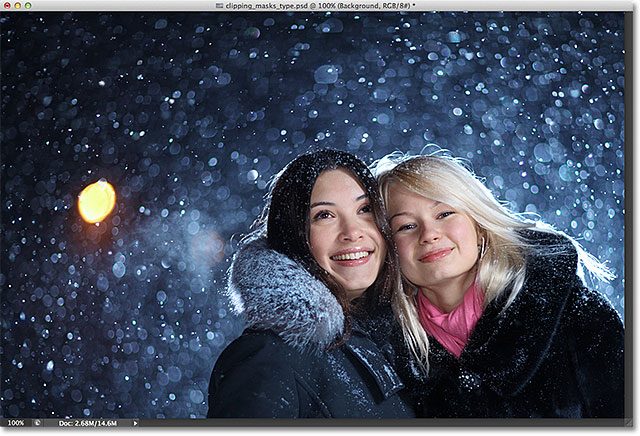
The master image that will be used equally the groundwork.
And if I turn on the top layer past clicking on its visibility icon in the Layers console:
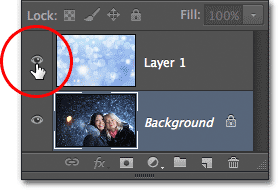
Clicking the layer visibility ("eyeball") icon for the top layer.
We see the image I'm going to be placing inside of some text (abstract winter groundwork from Shutterstock):
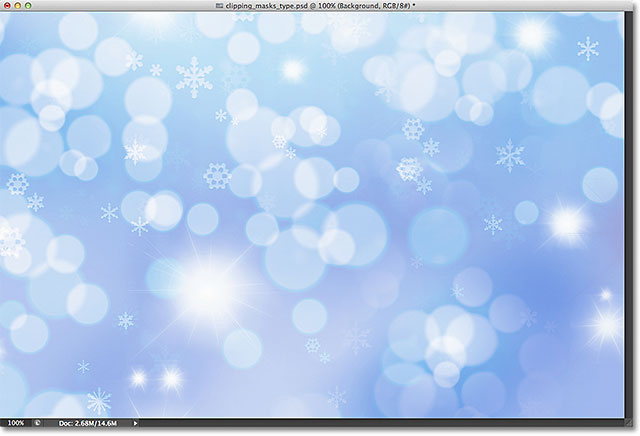
The image that will exist going inside the text.
Step 1: Add Your Text
Allow's become alee and add the text to the document. First, I want my text to appear in forepart of the other images for now (so I can run into what I'm doing) so before I add together any text, I'll click on the top layer in the Layers panel to select it and get in active:
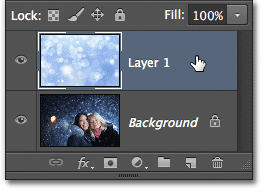
Selecting the top layer.
With the top layer selected, I'll add together my text. If you're looking for more than information on working with type in Photoshop, be sure to cheque out our full Photoshop Type Essentials tutorial, the first of several tutorials roofing everything you need to know. Here, I'll starting time by grabbing the Type Tool from the Tools panel:
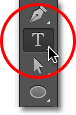
Selecting the Type Tool.
With the Blazon Tool selected, I'll choose my font up in the Options Bar forth the top of the screen. When you know you're going to be placing an image inside your text, you'll usually desire to cull a font with thick letters then you'll be able to see more of the image. I'll choose Impact since it'due south a nice thick font, and I'll prepare the initial size of my font to 24pt. Don't worry nigh choosing a color for the text because the color won't be visible one time nosotros've added the image:

Selecting the font options in the Options Bar.
With my font details called, I'll click within the document with the Blazon Tool to begin adding my text. I'll type the words "Happy Holidays":
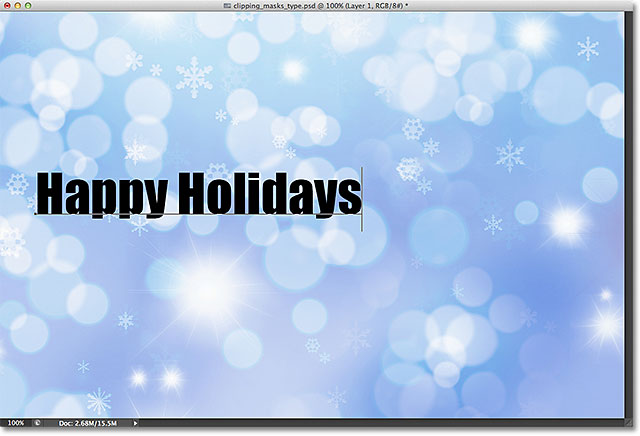
Adding the type to the certificate.
When you lot're washed, click the checkmark in the Options Bar to accept the type and exit out of text editing style:

Clicking the checkmark in the Options Bar.
If we look in the Layers panel, we encounter the new Type layer that's been placed above the other two layers. Photoshop places new Blazon layers directly to a higher place any layer was previously active which is why I first clicked on Layer 1 to select it before adding the text:
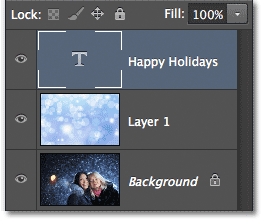
The Layers console showing the new Type layer.
Pace 2: Resize The Text With Free Transform
Unfortunately, the font size I chose in the Options Bar was too pocket-size for my design, only that'south okay because there's an piece of cake fashion to resize the text. We'll just use Photoshop'southward Free Transform command. I'll select it by going upward to the Edit menu in the Menu Bar along the elevation of the screen and choosing Free Transform. Or, I could press Ctrl+T (Win) / Control+T (Mac) on my keyboard to select Complimentary Transform with the shortcut. Either way is fine:
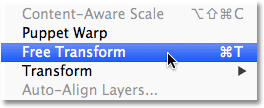
Going to Edit > Gratuitous Transform.
This places the Gratuitous Transform box and handles (piffling squares) around the type. To resize the type, I'll but click and drag the corner handles outward to brand the text equally large as I need it. I'll also agree down my Shift key as I'1000 dragging the handles to keep the original shape of the letters intact as I'm resizing them. When you're done, press Enter (Win) / Render (Mac) on your keyboard to accept the transformation and leave out of the Gratuitous Transform command:
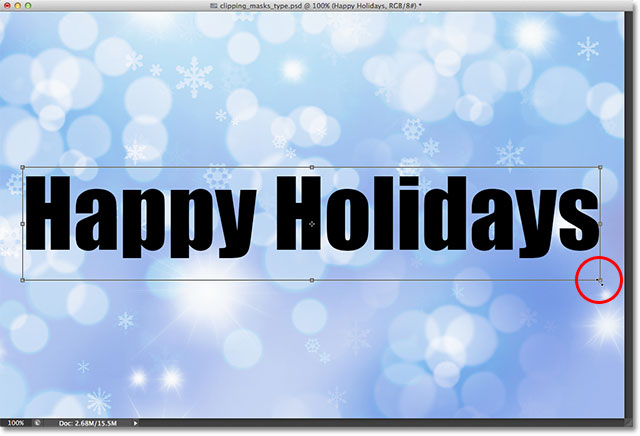
Holding Shift and dragging the corner handles to resize the text.
Pace three: Create A Clipping Mask
Now that the blazon is the size nosotros need, allow's go ahead and add our clipping mask to place the prototype inside the text. The epitome I desire to place inside my text is on Layer one, but Layer ane is currently sitting below my Blazon layer and as we learned in the Clipping Masks Essentials tutorial, nosotros need the layer that's going to serve as the clipping mask (in this case, the Type layer) to exist below the layer that's going to be "clipped" (Layer ane). This means I'll first demand to move my Type layer below Layer 1.
To movement the Type layer, I'll click on information technology in the Layers panel and with my mouse button held down, I'll begin dragging the layer down until I see a horizontal highlight bar appear between Layer 1 and the Background layer:
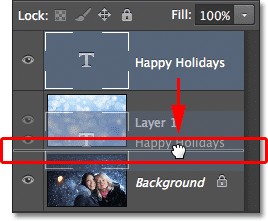
Dragging the Type layer below Layer 1.
When the highlight bar appears, I'll release my mouse button and the Type layer is moved right where I need information technology directly below Layer ane:
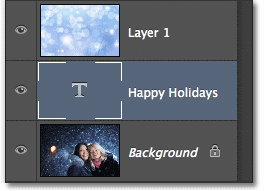
Layer ane now sits in a higher place the Type layer.
Next, nosotros need to brand certain we have the layer that's going to be "clipped" past the clipping mask selected, so I'll select Layer 1:
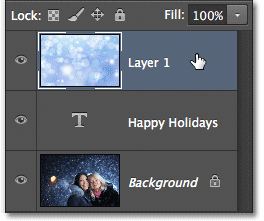
Selecting the image layer above the Type layer.
With the Type layer now directly below the image and the image layer selected, I'll add the clipping mask by going upward to the Layer menu at the top of the screen and choosing Create Clipping Mask:
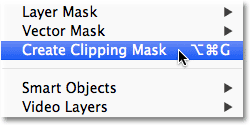
Going to Layer > Create Clipping Mask.
If we await over again in the Layers panel, nosotros see that Layer 1 is now indented to the right, with a minor pointer to the left of its preview thumbnail pointing downward at the Blazon layer below it. This tells usa that Layer ane is now beingness clipped by the Type layer:
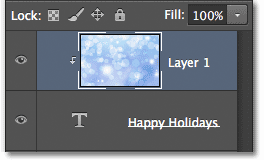
The Layers panel showing the clipping mask.
And if nosotros wait in the document window, we encounter that the image on Layer 1 now appears to be inside the text! Information technology's non really inside the text. Information technology only looks that way because any function of the image that is not sitting straight above the blazon is being subconscious from view thank you to the clipping mask:
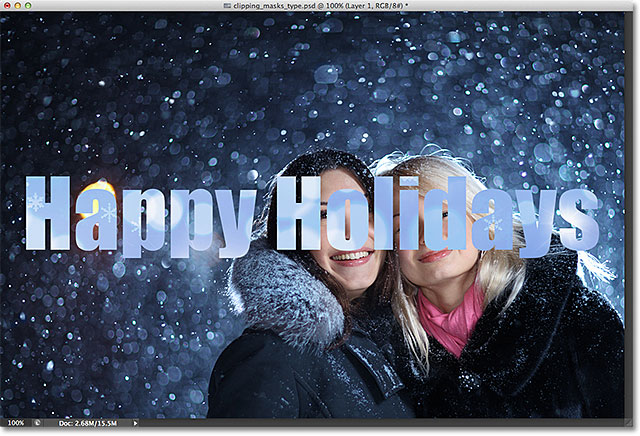
Photoshop is now hiding whatsoever part of the paradigm that is not sitting directly above the type.
Step 4: Reposition The Text
Of course, I picked a pretty bad spot to identify my text. Information technology's blocking the faces of the two people in the photo so I'll need to move the text into position. Showtime, I'll select the Type layer in the Layers panel:
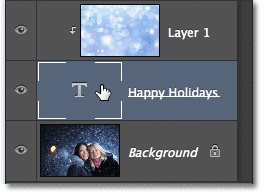
Clicking on the Type layer to select it.
Then I'll grab Photoshop'south Motion Tool from the peak of the Tools panel:
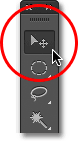
Selecting the Movement Tool.
With the Type layer selected and the Motility Tool in hand, I'll merely click on the text in the document and elevate information technology up above the two people in the photograph. Even though the text is moving, the image inside the text remains in place. It doesn't motility at all. Then with the text now above in the certificate, we meet a dissimilar part of the epitome inside the text. The text and the image within it tin can really be moved independently of each other, then if I wanted to, I could also select the image layer (Layer 1) in the Layers panel and, with the Motion Tool however in hand, drag the paradigm around inside the text to reposition it. This would move the image while the text remained in identify:
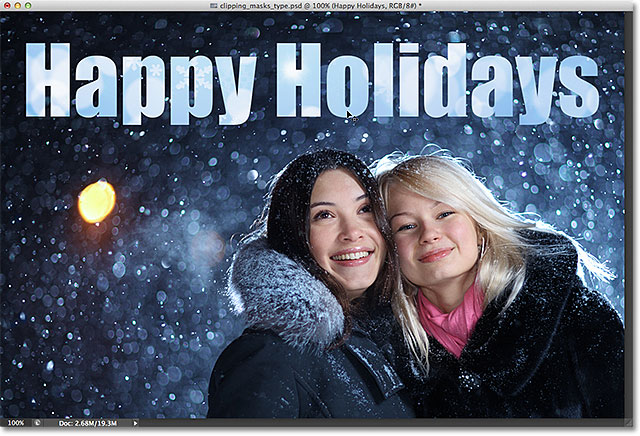
Employ the Move Tool to move the text, or the image inside the text (depending on which layer is selected in the Layers panel).
Even though the Type layer is existence used as a clipping mask, it's still officially type, which means it remains fully editable even with the epitome actualization inside of it. If y'all suddenly realized you made a spelling mistake, simply select the Blazon Tool, highlight the mistake by clicking and dragging over it, type the correction and then click the checkmark in the Options Bar to accept information technology. Or, if you don't like the font yous chose initially, again select the Type Tool, click on the Blazon layer in the Layers panel to brand it active, then cull a different font from the Options Bar (yous may demand to use Free Transform again to resize the type if you change fonts). Again, I cover all of these things and more beginning with our Photoshop Type Essentials tutorial.
Warping And Reshaping The Type
Likewise since the type is notwithstanding blazon, that ways yous tin even warp it into different shapes! First brand sure you lot have the Blazon layer selected in the Layers console, then go up to the Edit menu at the top of the screen, cull Transform, and then choose Warp:
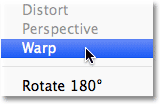
Going to Edit > Transform > Warp.
With the Warp command selected, look up near the far left of the Options Bar at the superlative of the screen and you'll encounter a Warp option that past default is set to None:

The Warp option in the Options Bar.
Clicking on the word None opens a drib-down list of several preset warp styles to cull from. Every bit an case, I'll cull one of the more than popular styles - Wave:
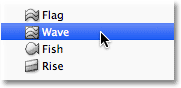
Choosing Wave from the list of preset warp styles.
This instantly warps the text into a fun "wave" shape, yet the clipping mask remains active with the image however appearing inside the text. Anything you can normally do with blazon in Photoshop, you can exercise with information technology even when it's existence used as a clipping mask:
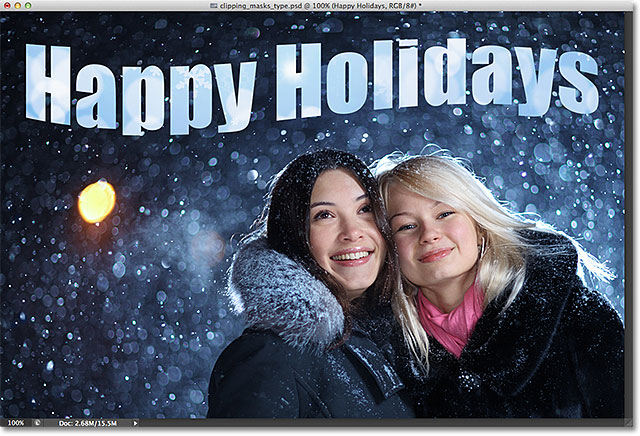
The text later applying the Warp command.
Calculation Layer Styles
We also learned in the Clipping Masks Essentials tutorial that we can add layer styles to clipping masks, and that's true even when using type. To speedily cease things off, I'll add together a layer style to the text to assist information technology blend in amend with the main photo backside it. First, I'll select the Type layer in the Layers panel:
Selecting the Type layer.
And then I'll click on the Layer Styles icon at the bottom of the Layers panel:
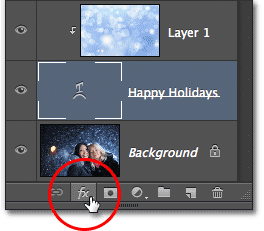
Clicking the Layer Styles icon.
I'll choose Outer Glow from the listing of layer styles that appears:
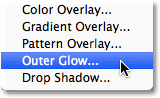
Choosing an Outer Glow style.
This opens Photoshop's Layer Style dialog box set to the Outer Glow options in the middle column. I'll change the color of my outer glow to white by clicking on the color swatch and choosing white from the Colour Picker that appears. And then I'll lower the Opacity of the glow to 30% and I'll increment the glow's Size to around 32px. Of course, these are just settings that piece of work well with my image here and are only meant to exist an case of how nosotros can add together layer styles to type while it'south being used as a clipping mask:
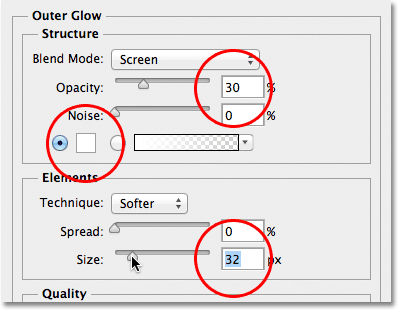
The Outer Glow options.
I'll click OK in the top right corner of the Layer Mode dialog box to shut out of information technology. We tin can run into the Outer Glow way listed below the Type layer in the Layers console:
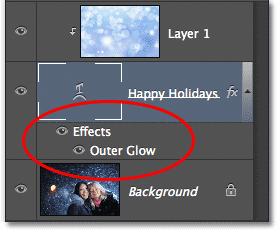
The Outer Glow manner appears below the Type layer.
And with that, we're washed! Here's my final consequence with the Outer Glow added to the text (I also used to Move Tool to move the blazon down but a flake then it appears more centered between the 2 girls and the acme of the image):
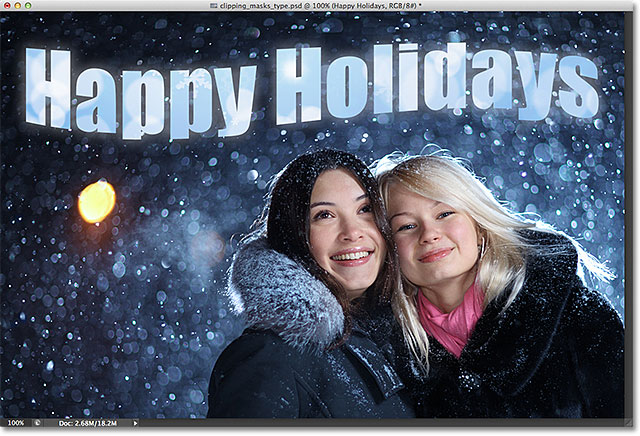
The final "image in text" issue.
Other Stuff
© 2022 Photoshop Essentials.com.
For inspiration, non duplication.
Site pattern past Steve Patterson.
Photoshop is a trademark of Adobe Systems Inc.
Source: https://www.photoshopessentials.com/basics/clipping-masks-and-type/
0 Response to "Can I Upload a Photo as Mask"
Post a Comment