Art Room Filled With Wax That Has Snails Eating Lettuce Washington Dc
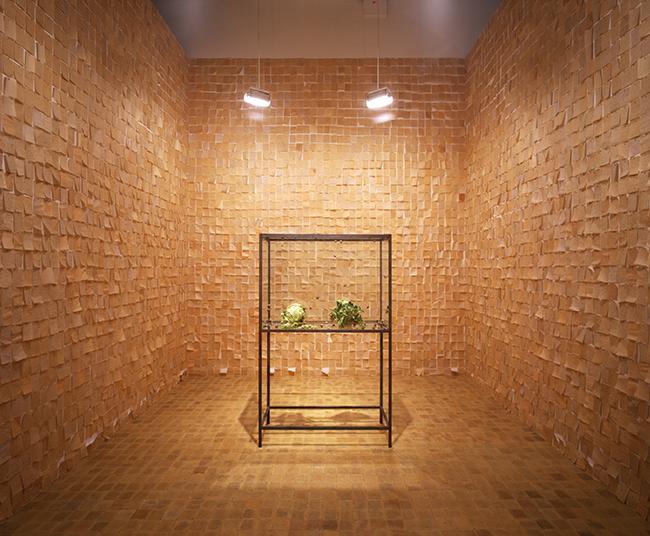
Ann Hamilton's palimpsest, 1989, at the New Museum of Contemporary Fine art in New York City—the floors are beeswax, the walls pinned by aged newsprint, with a glass cabinet containing snails eating cabbage in the middle of the room. Photo by Kathryn Clark, courtesy of Ann Hamilton Studio
On a recent morning at the Hirshhorn Museum and Sculpture Garden in Washington, DC, Main Conservator Gwynne Ryan was overseeing the de-installation of Alexander Calder'south Two Discs (1965) in the museum's outdoor plaza. Wearing a hard hat and cogitating vest, and monitoring a crane and coiffure of riggers, Ryan looked more like a construction foreman than a conservator. Simply considering other pieces have required her to learn how to preserve soap, chocolate, a floor made of beeswax, and to learn most the mating process of snails, possibly a turn as a foreman is ane of the less challenging roles Ryan has had to play. As Ryan put it, when it comes to conserving contemporary art, "You don't get bored."
In the past century or then, artists accept increasingly moved beyond the canvas, exploring natural materials, industrial materials, and daily ephemera—none of which were necessarily designed with durability in listen. While this has expanded our commonage notion of what art can be, it presents a continuous challenge for conservators, and calls into question what, exactly, should be preserved.
"Sometimes there are conceptual aspects or immaterial considerations that might supervene upon that of the textile," said Ryan. For example, what was the artistic intent? What is the artwork'south lifecycle? What is more than appropriate: rehabilitation of a piece to preserve the original, or replication, so that its overall aesthetic and meaning can be amend maintained?
To accost these complexities, artist interviews have get increasingly pop within contemporary fine art conservation. Carol Mancusi-Ungaro, Melva Bucksbaum Associate Director for Conservation and Research at the Whitney Museum of American Fine art, is a pioneer in artist documentation and began the Artist Documentation Program at Houston'due south Menil Collection in 1990. Described as "living wills" in a contempo New Yorker article, these interviews allow conservators to document the process, approach, and intent behind the piece, and assist them
determine the virtually advisable way to conserve the artwork moving forward. "It'due south really key to work with the artist and understand what ane is preserving," she said. "Is information technology the idea or the physicality?"
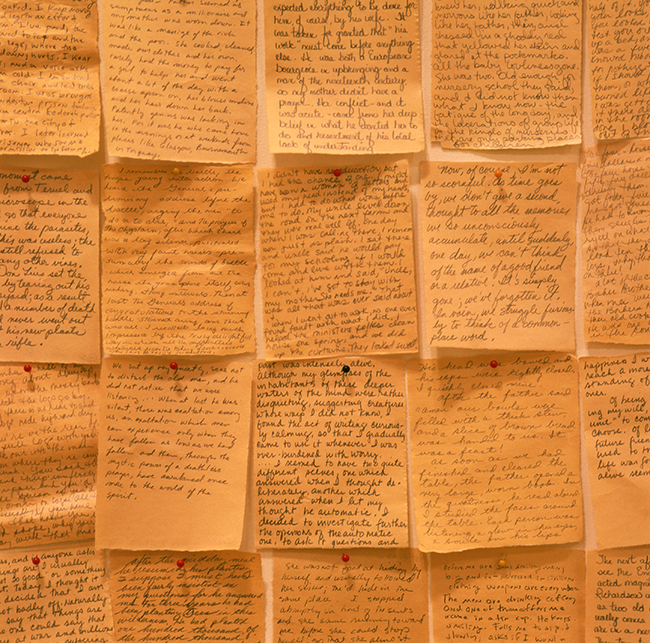
Some of the handwritten memories on the walls of the artwork palimpsest by Ann Hamilton. Photograph past Kathryn Clark, courtesy of Ann Hamilton Studio
Throughout the conservation process, every conclusion, action, and notable conversation is documented. This will hopefully foreclose future conservators from having to guess what was original and what was the work of restorers, and why any changes were made. "There are huge records of what is done, and the thinking backside what is done," said Mancusi-Ungaro. "With modern art, you accept the responsibility of being the first easily on [to conserve a piece]. So you're much more cautious with that."
Rather than wait until a slice suffers harm, the work of conserving gimmicky art begins at acquisition. The challenge, Ryan said, is to map out how to preserve a piece 50, 100, 500 years down the road when the artwork itself is still in its infancy. "Sometimes the artist is still making [a piece], and figuring out what it is they're even making," she said. "For us to be trying to empathise what it is going to mean to ain this, or what elements tin can dethrone, what elements can be replaced—I find it fascinating. Even when an artwork is coming into the collection, it is still becoming."
Sometimes, she said, conversations with an artist lead to an approach that "we admittedly never would accept thought of on our own," and might fifty-fifty be considered improper had information technology not been personally sanctioned by the creative person. For case, the Hirshhorn acquired in 2004 the room-sized installation palimpsest (1989) by Ann Hamilton, a 1993 NEA Visual Arts Fellow and 2014 National Medal of Arts recipient. A meditation on the loss and preservation of retentiveness, the piece of work consists of floor tiles hand-bandage from beeswax, and walls pinned with squares of aged newsprint scrawled with handwritten memories, which palpitate in the breeze of an oscillating fan. In the center of the room is a vitrine total of snails munching on heads of cabbage.
"Well-nigh all of the components are utilized in a way that is not going to help their preservation," Ryan laughed. Nor were they necessarily meant to be preserved. In a recent interview, Hamilton noted that the newsprint was meant to disappear with fourth dimension, and the snails, evidently, had a shelf life. "When a piece is saved, and it needs to be stabilized, what problems does the intention of ultimate disappearance come to have?" Hamilton mused. "How is piece of work that's nigh change and without business firm edges considered within a museum collection? Those are things I'm still trying to figure out."
After a series of conversations between Ryan and Hamilton, the Hirshhorn ultimately decided to host a multigenerational workshop for docents and teens where they wrote their own fragments of memories on news- print squares. These will and then be used to supplant the original newsprint once it becomes too breakable or faded to display. Information technology was an unconventional approach to conservation that both Hamilton and Ryan feel will proceed the piece alive, rather than "freezing it in time and treating those elements as if they're precious," said Ryan.
It'due south a sentiment artist Patrick Dougherty shares. Dougherty, who received an NEA Visual Arts Fellowship in 1990, constructs large-scale, architectural installations made entirely of constitute sticks, which look at in one case entirely fantastical and somewhat primitive. The works aren't designed with posterity in mind, and typically dethrone within 2 or three years. For Dougherty, this impermanence "turns the attention of an artwork dorsum to what I recall it should exist—non something that's permanent or that you lot can buy and sell and gain a return on your investment. It refocuses on the 'now' experience of looking at a work and only existence compelled by it."
While it's an idea that might trouble art historians, Dougherty isn't concerned about the time to come. The associations that people have with sticks, which oftentimes stem from childhood or the natural earth, are what make his sculptures resonate, and he isn't sure the emotional impact would be the same—today or for future generations—if the aforementioned sculptures were fabricated from different, more than durable materials. Because his works are almost exclusively outdoors, and seen past thousands of intentional visitors and happenstance passersby, Dougherty reasons that the emotional touch of his piece of work is compressed "into a few weeks" instead of what would have centuries in a museum.
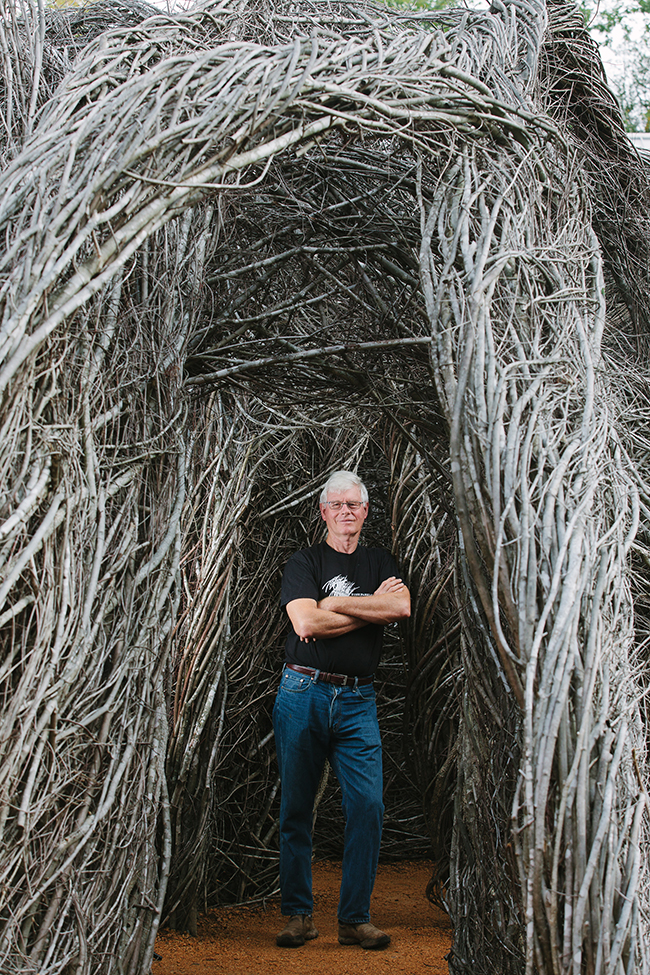
Sculptor Patrick Dougherty in ane of his works. Photograph by Brianna Brough/Chapel Colina Mag
Currently even so, he does have two museum works on view, one at the North Carolina Museum of Art and the second at the Renwick Gallery in Washington, DC. The latter, titled Shindig and fabricated of willow branches, was commissioned past the Renwick as part of its exhibition
WONDER, which historic the museum's reopening after a two-year renovation. Dougherty said the Renwick is choosing not to keep and conserve the piece long-term, partly due to concerns over protrude infestations and burn dangers. It's an consequence that illuminates not only the vulnerability of certain unconventional materials, but their potential upshot on other pieces in a collection.
And yet, we live in an age where even ephemeral piece of work volition likely endure far longer than was in one case possible, at least in some class. "I think many of the materials that nosotros see as beingness 'unconventional' probably have been art-making materials for a lot of people through the generations," Ryan said. "We just don't have it around to see." But with photographic camera photos, blogs, videos, and criticism all online, temporary work has been given seemingly infinite means to live on. Since WONDER opened in November, the Renwick had been tagged approximately threescore,000 times on Instagram, giving the nine larger-than-life works on display—Dougherty's included—a way to survive digitally if not physically.
And peradventure ane day that is how all artwork will survive. Despite the creative person's wishes, a conservator's efforts, the documentation process, or a museum board's concerns, "Things have a life," said Ryan. "As much as we want to try and keep everything in perfect condition as long as nosotros can, ultimately chemical science takes over and physics happens."
Dougherty agrees. As he put it, "I've ever idea that everybody does temporary work."
Source: https://www.arts.gov/stories/magazine/2016/2/challenges-arts-21st-century/idea-or-physicality
0 Response to "Art Room Filled With Wax That Has Snails Eating Lettuce Washington Dc"
Post a Comment